"Don't forget to use the discount coupon code at the checkout page”

Preparing for Christmas: The Meaning of Advent and Its Four Candles

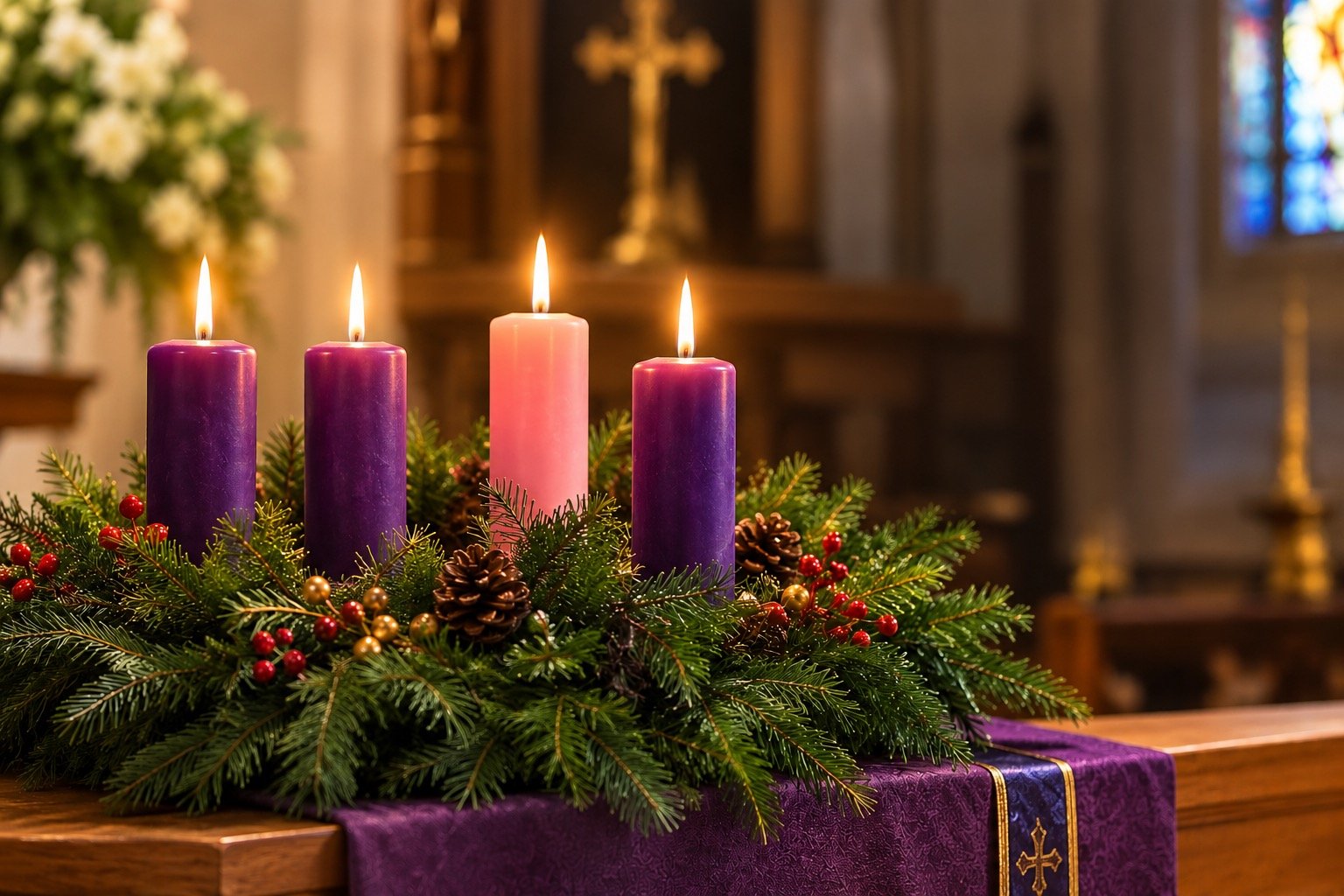
Long before Christmas Day arrives, the Catholic Church begins preparing to celebrate the birth of Jesus Christ through the season of Advent. It is a time of prayer, hope, reflection and joyful expectation as the faithful prepare their hearts for the coming of the Lord.
One of the most recognisable symbols of this season is the Advent wreath, with its four candles representing the four Sundays leading up to Christmas. Each candle marks another step in the Church’s spiritual journey towards the Nativity of Our Lord.
What Is Advent?
The word Advent comes from the Latin adventus, meaning “coming” or “arrival.” In the Catholic Church, Advent marks the beginning of the liturgical year and prepares the faithful for Christmas.
The season has a twofold character: it recalls the preparation for Christ’s first coming at Bethlehem and directs our attention towards His promised coming in glory.
Advent is traditionally marked by prayer, reflection and a spirit of watchful expectation. In churches, the liturgical colour violet expresses a season of preparation, while rose is used on the Third Sunday of Advent, known as Gaudete Sunday, to express a note of joy.
What Is the Meaning of the Four Advent Candles?
The Advent wreath is commonly made with evergreen branches and four candles, arranged in a circle. Each candle is lit on a successive Sunday of Advent.
Although individual traditions assign different names and themes to the candles, the wreath as a whole represents the growing light of Christ as Christmas approaches.
The First Candle: Hope
The first candle is often violet and is associated with hope and expectation.
It reminds Christians of God’s promises and the longing of the people of Israel for the coming of the Messiah. As this candle is lit, the faithful begin the Advent journey with renewed trust in God’s faithfulness.
The Second Candle: Peace
The second violet candle is commonly associated with peace and preparation.
It encourages the faithful to make room for Christ through prayer, reconciliation and acts of charity. It also recalls the prophets who announced the coming of the Saviour.
The Third Candle: Joy
The third candle is rose-coloured and is lit on Gaudete Sunday.
The word Gaudete means “rejoice.” This Sunday offers a joyful pause within the penitential character of Advent, reminding the faithful that the celebration of Christ’s birth is drawing near.
The rose candle is a distinctive feature of the Advent wreath and reflects the Church’s invitation to rejoice in the Lord.
The Fourth Candle: Love
The fourth candle is usually violet and is often associated with love.
It invites Christians to reflect on God’s love revealed through the gift of His Son. As Christmas approaches, the faithful are encouraged to express that love through generosity, forgiveness and care for others.
The names and symbolic meanings assigned to individual candles vary among Christian traditions, but all four candles point towards the hope and expectation of Christ’s coming.
Should an Advent Wreath Have a White Candle?
A traditional Advent wreath generally has four candles: three violet and one rose. A white candle is not normally part of this traditional arrangement.
However, some families and churches use a separate white Christ candle, placed in the centre of the wreath, which is lit at Christmas. This candle symbolises Christ, the Light of the World, and marks the transition from Advent preparation to the celebration of His birth.
The central white candle is an optional custom rather than a required part of the traditional four-candle Advent wreath.
Preparing the Church for Advent
The Advent wreath is often placed in a prominent position in the sanctuary, where it can be seen during the celebration of Mass. Its greenery and candles provide a simple but meaningful visual reminder of the season.
Churches may also prepare their vestments, altar decorations and other liturgical items in keeping with Advent’s more restrained character.
Violet vestments are used during Advent, while rose vestments may be worn on Gaudete Sunday where the liturgical norms permit. These colours help distinguish the season of preparation from the joyful celebration of Christmas.
From Advent Preparation to Christmas Joy
Advent invites us to prepare not only our churches but also our hearts. The gradual lighting of the four candles reminds us that even a small light grows more visible in the darkness.
As the final days of Advent approach, the Church turns with joyful expectation towards Bethlehem and the birth of Jesus Christ.
May the light of the Advent wreath remind every family and parish to grow in hope, peace, joy and love as we prepare to celebrate the coming of our Saviour.